
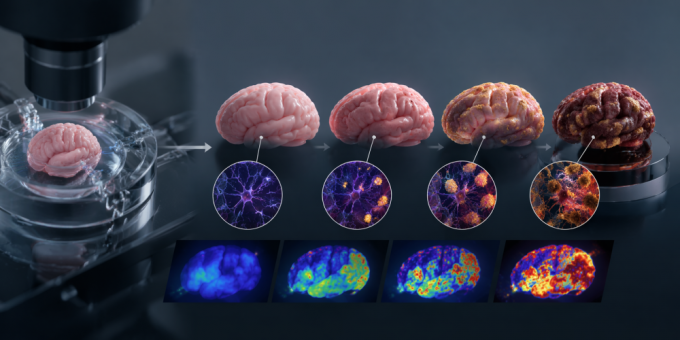
Alzheimer’s disease is one of the most common neurodegenerative disorders. Despite recent advances in drug development, selecting the most effective treatment for individual patients remains a major clinical challenge. Many available therapies benefit only a subset of patients, and accurately predicting which treatment will work best for a particular individual has proven difficult.
To address this challenge, researchers at Johns Hopkins University developed an innovative approach using stem cells derived from patients to create miniature three-dimensional brain models in the laboratory. These brain organoids replicate many key characteristics of human neurons, allowing scientists to evaluate how each patient’s brain tissue responds to different medications before treatment is prescribed.
The study found that these laboratory-grown brain models did not respond uniformly to Alzheimer’s drugs. In other words, a medication that proved effective for one patient could be significantly less effective for another. The findings underscore the importance of personalized medicine in Alzheimer’s care, where treatments are tailored to each individual’s biological characteristics rather than relying on a one-size-fits-all approach.
Researchers also discovered that these brain models release tiny particles known as extracellular vesicles. These vesicles contain valuable information about the condition of nerve cells and may eventually serve as biomarkers for the early diagnosis of Alzheimer’s disease, monitoring disease progression, and evaluating treatment effectiveness.
According to the research team, the technology could also transform the drug development process. Instead of moving directly into expensive human clinical trials, pharmaceutical companies could first evaluate potential therapies using patient-derived brain models. This approach could reduce research and development costs while increasing the likelihood of success during clinical testing.
The potential applications of the technology extend far beyond Alzheimer’s disease. Researchers believe the same strategy could be used to study Parkinson’s disease, amyotrophic lateral sclerosis (ALS), autism spectrum disorders, and certain psychiatric conditions. As a result, laboratory-grown brain models are rapidly emerging as a promising field within digital health, regenerative medicine, and biomedical research.
Experts also suggest that combining this technology with artificial intelligence could further revolutionize medicine. Machine learning algorithms can analyze the vast amounts of data generated by these brain models, identify patterns that may not be apparent to researchers, improve drug selection, support personalized treatment design, and even help discover new therapeutic targets.
Although the technology remains in the research stage and requires further validation before widespread clinical use, the study offers renewed hope for millions of people living with Alzheimer’s disease and their families. Many experts view this achievement as a significant step toward the transition from generalized treatment approaches to precision and personalized medicine, an evolution that could reshape the future of neurological disease treatment.
Source: S.C.I.