
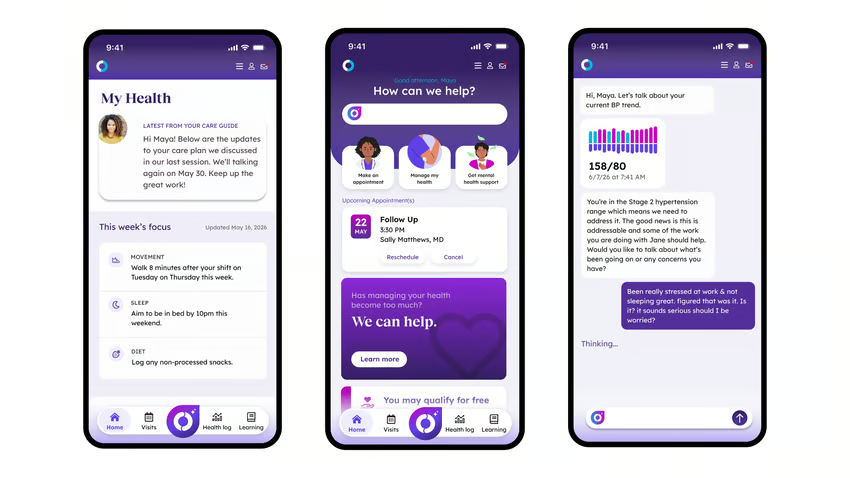
Following the unprecedented boom in telemedicine during the COVID-19 pandemic, the digital health industry has entered a new phase in which investors, insurers, and employers are demanding stronger evidence of clinical effectiveness and return on investment. In response to these market expectations, Teladoc Health has introduced a value-based care model that ties a portion of its reimbursement to patient outcomes rather than the volume of services delivered.
Under traditional healthcare payment systems, providers are typically compensated for each consultation, visit, or medical service, a model widely known as fee-for-service. Teladoc’s new approach, however, links part of its revenue to measurable outcomes such as improvements in patient health, reductions in avoidable hospitalizations, better chronic disease management, and lower overall healthcare costs.
The shift reflects a broader transformation across digital health, where success is increasingly defined not by the number of virtual visits provided but by the measurable impact those services have on patient health. In other words, healthcare technology companies are being evaluated on outcomes rather than activity alone.
Experts believe this model better aligns the interests of the three key stakeholders in healthcare. Patients benefit from more personalized care and continuous monitoring, insurers reduce unnecessary medical spending, and digital health providers can achieve stronger financial performance by delivering demonstrably effective care.
Over the past several years, Teladoc has made significant investments in remote patient monitoring, chronic disease management, behavioral health services, and advanced healthcare analytics. These capabilities enable the company to continuously monitor patients and personalize clinical interventions using data-driven insights.
Artificial intelligence has also become a central component of this transformation. AI-powered systems can analyze data from wearable devices, electronic health records, and medical histories to identify high-risk patients before serious complications develop. Such predictive capabilities can help reduce emergency department visits and hospital admissions while lowering overall healthcare expenditures.
The global digital health market is becoming increasingly competitive, with companies including Teladoc, Amazon Clinic, CVS Health, UnitedHealth, and numerous emerging startups competing for market leadership. In this environment, demonstrating the economic value of healthcare services is expected to become one of the industry’s most important competitive advantages.
Industry analysts argue that Teladoc’s initiative represents more than a change in pricing strategy, it signals the continued maturation of the digital health sector. If successful, the model could encourage more healthcare organizations to adopt outcome-based contracts, accelerating the adoption of value-based care as an industry standard.
The transition is also highly relevant for healthcare systems worldwide. Rising medical costs, the growing burden of chronic diseases, and persistent workforce shortages are driving governments and healthcare providers toward greater adoption of digital technologies. In this context, care models capable of simultaneously improving quality while reducing costs are likely to gain broader acceptance.
Ultimately, Teladoc’s latest initiative can be viewed as part of a broader transformation in healthcare economics, one in which the success of digital health companies will increasingly be measured not by the size of their user base, but by their ability to improve patient outcomes and reduce the overall cost of care.
R: F.H.