
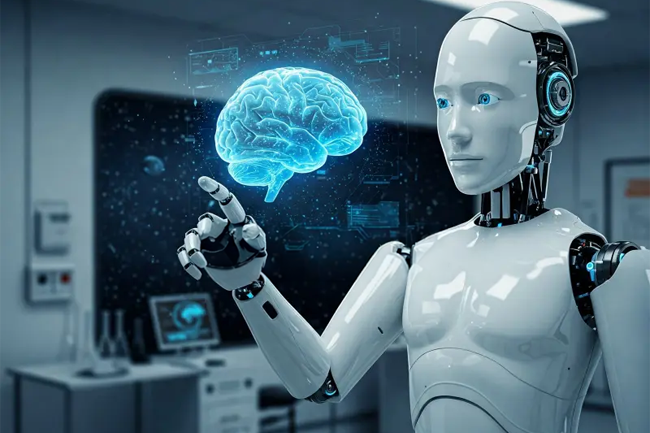
Computer scientist Peter J. Denning argues that artificial intelligence research has been built on a fundamental misconception for the past seven decades, and that, as a result, machines are unlikely ever to achieve human-level intelligence.
In a recent essay titled “The Turing Mistake: Escaping the Tyranny of Stupid Machines,” Denning revisits the ideas of Alan Turing, widely regarded as the father of theoretical computer science. He argues that the long-held assumption that human intelligence can be separated from the body and recreated purely as software has led AI research down the wrong path from the very beginning.
Denning also challenges the Turing Test, which has long been regarded as a benchmark for machine intelligence. In his view, a machine’s ability to imitate human conversation does not demonstrate genuine understanding or human-like intelligence.
According to Denning, the greatest obstacle to achieving human-level AI is tacit knowledge, the knowledge people acquire through lived experience and continuous interaction with their physical, social, and cultural environments but cannot fully express through words or explicit rules.
This form of knowledge encompasses common sense, intuition, emotions, practical experience, personal skills, and cultural and historical understanding, qualities that, Denning argues, no algorithm has yet been able to reproduce.
To illustrate his point, he cites the Cyc project, an ambitious effort launched in the 1980s to build the world’s largest common-sense knowledge base for computers. After more than four decades of work, the project accumulated roughly 25 million facts and assertions, yet it still failed to give computers genuine human-like understanding.
Denning argues that many of the abilities that make people true experts simply cannot be translated into explicit rules or instructions.
He distinguishes between “knowing that”, factual knowledge, and “knowing how”, the practical skills acquired through experience. While machines can be taught facts and formal rules, he contends that experience-based skills rooted in intuition and feeling cannot be transferred in the same way.
To explain this distinction, Denning points to the example of a professional violinist. A master musician may produce an extraordinary performance without being able to fully explain how it was achieved. Likewise, even if a robot could perfectly replicate every physical movement, it would never experience the emotions involved in performing the music or understand its emotional impact on an audience.
According to Denning, the core limitation of AI lies in knowledge representation. Computers can process only information that has been translated into a machine-readable form, whereas much of human experience cannot be encoded in that way.
He further argues that words are merely symbols of meaning, not meaning itself. Consequently, large language models such as ChatGPT, Claude, and Gemini process statistical relationships between words rather than genuinely understanding the concepts they generate.
Denning also emphasizes the importance of context in human communication. The meaning of a sentence can change dramatically depending on the situation, tone, relationships between speakers, cultural background, and previous conversations, factors that today’s AI systems still struggle to fully comprehend.
He argues that simply scaling up language models or building larger neural networks will not overcome these limitations, because culture, values, social norms, human relationships, and lived experience emerge from participation in the real world, not from processing billions of words.
At the same time, Denning warns that the fact AI may never achieve human-level general intelligence does not mean it is harmless. Networks of autonomous AI systems operating at large scale could still produce serious and unpredictable societal consequences, even without possessing human intelligence.
In his view, the greatest future challenge is unlikely to be domination by a superintelligent AI. Instead, it will be the growing deployment of AI systems whose goals and decision-making processes differ fundamentally from those of humans, creating a gap in mutual understanding. As AI continues to advance, Denning argues, society should place greater value on the qualities that distinguish humans from machines, including creativity, intuition, culture, empathy, and lived experience, because these remain the defining boundaries between human and artificial intelligence.